Stock Count Sheet: Layout, Variance Analysis and a Free Excel Template
A count sheet that sets the book quantity against the counted quantity, the four causes of a count variance and the order in which to close it — with a free template that calculates the variance and the accuracy rate for you.
What is a stock count sheet?
A stock count sheet — also called an inventory count sheet — compares the quantity physically counted in a warehouse with the quantity in the records, line by line, and records the difference together with its cause. It has two quantity columns, and the real work starts in the third: the book quantity, the counted quantity and the variance. The sheet earns its keep not by finding the variance but by recording why it happened — a variance with no cause written next to it tends to come back at the next count.
Free stock count sheet (Excel)
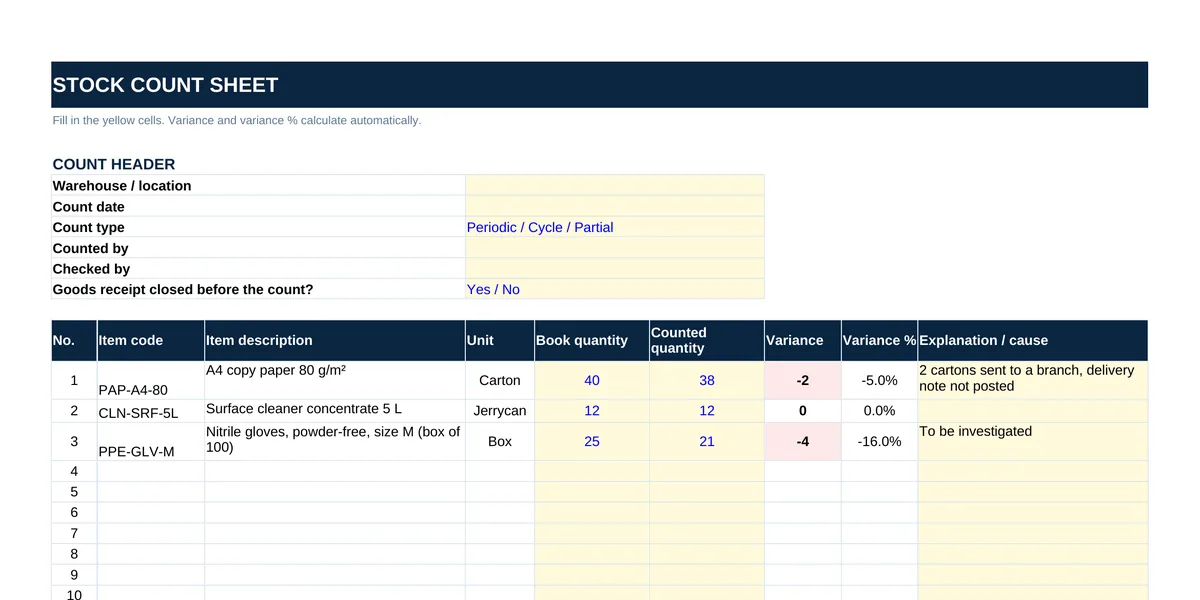
Enter the book quantity and the counted quantity; the variance, the variance percentage and the summary figures calculate automatically. Lines with a variance are highlighted. A 25-line table with three example lines; it prints on A4 landscape and needs no sign-up.
The example lines in the template are there to be deleted. The accuracy rate is an operational indicator, not a legal or accounting measure.
 — open full-size image
Which fields does the sheet need?
A count sheet has two blocks: a header that identifies the count itself, and the item table. The header is easy to leave out of a template, yet when a variance is questioned six months later the first things anyone asks are when the count was done, who did it and under what conditions.
| Field | Why it is needed |
|---|---|
| Warehouse / location | In a multi-site business, pins down where the variance is |
| Count date | The cut-off point: movements after this date are not part of the count |
| Count type | Periodic, cycle or partial — how you read a variance depends on it |
| Counted by and checked by | A second check is the cheapest way to tell a counting error from a real loss |
| Goods receipt closed? | If goods keep arriving during the count, a variance appears between counted and book quantity that is not real |
| Item code and description | With a description alone, similar items get mixed up |
| Unit | A variance may not be a variance at all but a unit mismatch — cartons or single pieces |
| Book quantity / counted quantity | The two sides of the comparison |
| Variance and variance % | The percentage puts the absolute difference in proportion: 2 out of 1,000 is not the same as 2 out of 10 |
| Explanation / cause | The real value of the sheet. A variance left without a cause is a variance left open |
What does a count variance mean? Four causes
When a count shows a variance, the first thought is loss. But variances also come from causes other than loss, and those should be ruled out first. Four causes, four different actions:
| Cause | How to recognise it | What to do |
|---|---|---|
| Unposted receipt or issue | The variance is negative and the item turns up at another location; or it is positive and there is a delivery whose goods receipt was never closed | Post the delivery note, goods receipt or transfer retrospectively |
| Unit error | The variance is proportional to the pack size (for example exactly five times) | Correct the unit on the item record; otherwise this variance repeats |
| Return or write-off posted late | The variance is positive, or matches a known damage record | Correct the return or write-off entry to the count date |
| Actual loss | What remains after the other three are ruled out | Correct the record and investigate the cause separately |
Look at the variance percentage, not the absolute variance. A shortfall of 2 cartons in 1,000 is 0.2% and may be a counting error; 2 boxes short out of 10 is 20% and needs an explanation. That is exactly what the variance % column in the template is for.
Types of count: periodic, cycle, partial
- Periodic count (a full physical inventory): the whole warehouse is counted at set intervals — year end, quarter end. Complete, but it stops the warehouse.
- Cycle count: a group of items is counted every day or every week, so that every item has been counted at least once over the year. The warehouse keeps running and variances are caught early.
- Partial count: only a chosen group is counted — critical items, expensive items or items with a recurring variance.
One arrangement that can work for small and mid-sized warehouses is a mix: a periodic count at year end, and cycle counts during the year for critical and expensive items. The same sheet serves all three; write the type in the header.
Before the count
- Announce the count date and time in advance; prepare the team and the count list.
- Close goods receipt and dispatch — or keep incoming goods in a separate area, outside the count. A good share of variances is prevented here.
- Post outstanding delivery notes, transfers and returns to the system BEFORE the count.
- Tidy the racks for counting; if the same item sits in more than one place, bring it together.
- Have the person who counts and the person who keeps the records be different people; plan a second check count where you can.
- Freeze the book quantity at the moment of the count and write it on the sheet as it stands.
If you prefer the counters not to see the book quantity while they count, print the sheet with the book quantity column empty and fill it in afterwards. The variance columns stay empty until both quantities are in, so read the summary only once every book quantity has been entered.
How to read the accuracy rate
The accuracy rate is the number of lines counted without a variance divided by the number of lines counted. The rate from a single count says little on its own; the trend says more. If it falls from count to count, the problem may well be late posting of stock movements rather than theft.
Note that it measures the number of lines, not their value: a perfect score on a hundred cheap items can hide a large variance on one expensive item. That is why expensive items are tracked separately — the logic of setting a reorder point and safety stock for critical parts applies here too.
After the count: closing the variance
A count ends not when the variance is found but when it is closed. The order: separate the lines with a variance → rule out the four causes above one by one → correct the record → write the basis for the correction on the sheet → sign and file the sheet.
Filing matters: if the same item shows a variance again at the next count, you have the previous record to compare with. A recurring variance is a different problem from a one-off one, and it can be fixed in the process — in how the unit is defined, in how movements are posted.
Restocking what the count shows
AKSCO is an İstanbul-based procurement partner. We do not hold stock of our own: we take your list, source each line and send a written, itemised quote — within 1 business day on standard items — with the lead time shown line by line. If the count shows consumables you need to replenish — office supplies, cleaning and hygiene, PPE, industrial consumables — send the list with item description, unit and quantity, or email the sheet itself to info@aksco.com.tr. We deliver to the delivery point named on the quote, anywhere in Türkiye or, for buyers abroad, as an export shipment — see export shipping from Türkiye. A quote request creates no obligation to order.
Frequently Asked Questions
What is a stock count sheet?
A document that compares the quantity physically counted in a warehouse with the quantity in the records, line by line, and records the difference with its cause. It has two blocks: a header (warehouse, date, count type, who counted and who checked) and an item table (item code, description, unit, book quantity, counted quantity, variance, explanation).
How do you do a stock count?
In three stages. Preparation first: announce the count, close goods receipt and dispatch or keep incoming goods in a separate area outside the count, post outstanding delivery notes, transfers and returns, and freeze the book quantity. Then the count: the person counting and the person keeping the records are different people; for each line the book quantity, the counted quantity and the variance go on the sheet. Finally, closing the variance: separate the lines with a variance, rule out the four causes in turn, correct the record, write the basis for the correction on the sheet, then sign and file it.
Why do count variances happen?
For four reasons: (1) a receipt, issue or transfer that was not posted, (2) a unit error — booked in pieces instead of cartons, (3) a return or write-off posted late, (4) actual loss. Actual loss is the last candidate: rule out the first three first. A variance proportional to the pack size (for example exactly five times) is a strong sign of a unit error.
How often should stock be counted?
It depends on how the business runs. A periodic count can be done at year end and at quarter ends; in cycle counting a group of items is counted each week and every item has been counted at least once over the year. One arrangement that can work for small and mid-sized warehouses is a mix: a periodic count at year end and cycle counts during the year for critical and expensive items.
Should the warehouse be closed during a count?
Closing it, or keeping incoming goods in a separate area outside the count, prevents a good share of variances from the start. If goods receipt and dispatch stay open while the count runs, an item can move after it has been counted and a variance that is not real ends up on the sheet.
What is the stock accuracy rate?
The number of lines counted without a variance divided by the number of lines counted. The trend from count to count matters more than the rate from a single count. Because it counts lines, it can hide value: a perfect score on a hundred cheap items can mask a large variance on one expensive item, which is why expensive items are tracked separately.
Related guides
Consumables Stock Card Template
Free Excel bin card: balance, reorder point and order list per item.
Read moreSpare Parts Min/Max and Reorder Point Calculator
Safety stock and reorder point for the items you cannot run out of.
Read morePurchase Request Form Template
Turn the lines the count found short into a request — free Excel.
Read moreMinimum Order Quantity and True Unit Cost Calculator
What pack multiples and minimum orders do to the real unit cost.
Read moreLogistics & Warehouses
Packaging, handling and warehouse consumables from one supplier.
Read moreSend your list — your quote is ready within 1 business day.
A list, a photo or an Excel file — whatever is easiest. On standard items we aim to quote the same business day. Custom production, imports or 50+ line lists can take longer; when they do, we tell you the timeline in writing on the day we receive the request.