PPE Matrix Template: Free Risk × Body Part Matrix in Excel
Which part of the body is exposed to which risk? A free Excel PPE matrix built on Annex I of the EU directive on PPE use at work, with steps to fill it in and the Annex II list of PPE types.
What is a PPE matrix?
A PPE matrix is a table that sets the risks at work against the parts of the body to be protected, so you can see where personal protective equipment (PPE) may be needed. The term does not appear in the annexes to Council Directive 89/656/EEC, the EU directive on the use of PPE at work; a model for it is Annex I to that directive: 14 body-part rows, from the cranium to the whole body, against 26 risk columns in physical, chemical, biological and other groups. The free Excel below keeps those rows and columns as worded in the annex. You mark the cells your risk assessment identifies and write the PPE required for each row.
Free PPE matrix template (Excel)
The Annex I matrix with 14 body-part rows and 26 risk columns: write X in a cell and it turns red, then write the PPE required for each row. A second sheet gives the Annex II list of PPE types as worded in the directive.
General template based on the annexes of Directive 89/656/EEC; it does not replace your risk assessment. Not legal advice.
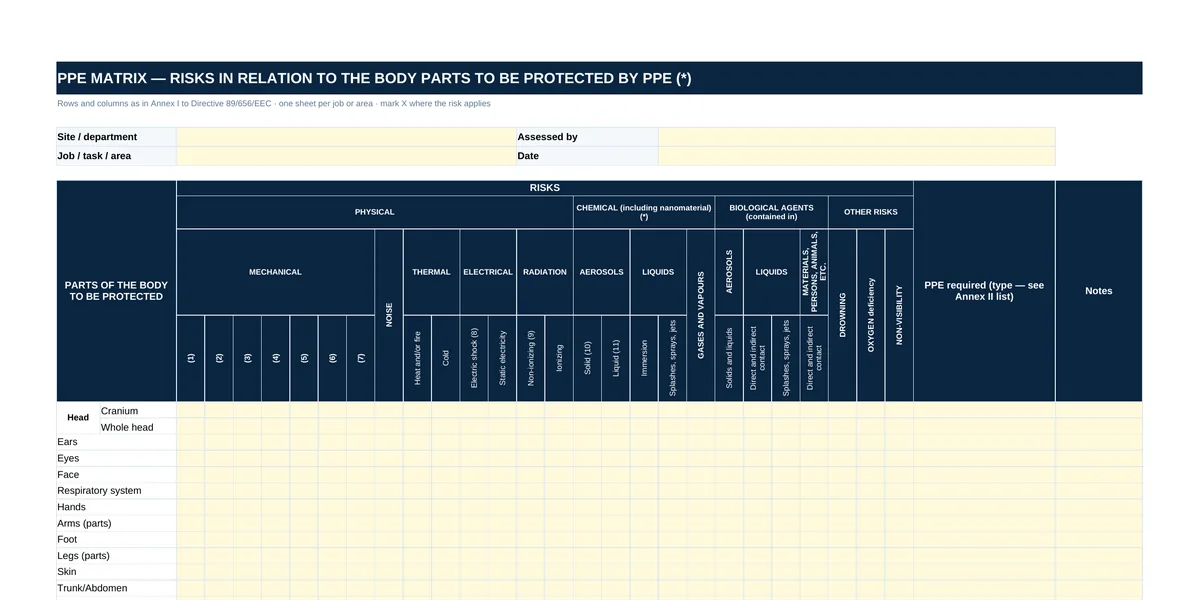 — open full-size image
How to fill in a PPE matrix
- Use one sheet per job, task or work area, and fill in the site, the job, who made the assessment and the date.
- From your risk assessment, write X in each cell where that part of the body is exposed to that risk. Annex I says its list of risks and parts of the body “cannot be expected to be exhaustive”, so write any other risk you identify in the Notes column.
- For each marked row, write the type of PPE required in the words of the Annex II list — for example, gloves against chemical risks. The Excel’s second sheet has the full list.
- Decide the characteristics — standard, class, size — from the risk assessment, then turn the rows into a purchase list and record each item issued in a PPE register.
Annex I: the rows and columns
| No. | Part of the body |
|---|---|
| 1 | Head — Cranium |
| 2 | Head — Whole head |
| 3 | Ears |
| 4 | Eyes |
| 5 | Face |
| 6 | Respiratory system |
| 7 | Hands |
| 8 | Arms (parts) |
| 9 | Foot |
| 10 | Legs (parts) |
| 11 | Skin |
| 12 | Trunk/Abdomen |
| 13 | Partial body |
| 14 | Whole body |
| Risk group | Columns |
|---|---|
| Physical | Mechanical: (1) Impact caused by falling or ejected objects, collision with an obstacle and high-pressure jets; (2) Falls due to slipping; (3) Falls from a height; (4) Vibration; (5) Static compression of parts of the body; (6) Mechanical injuries (abrasion, perforation, cuts, bites, wounds or stabs); (7) Entanglement and trapping · Noise · Thermal: Heat and/or fire; Cold · Electrical: Electric shock (8) — Direct or indirect contact; Static electricity · Radiation: Non-ionizing (9) — Including sunlight (other than direct observation); Ionizing |
| Chemical (including nanomaterial) | Aerosols: Solid (10) — Dusts, fumes, smokes and fibres; Liquid (11) — Mists and fogs · Liquids: Immersion; Splashes, sprays, jets · Gases and vapours |
| Biological agents (contained in) | Aerosols: Solids and liquids · Liquids: Direct and indirect contact; Splashes, sprays, jets · Materials, persons, animals, etc.: Direct and indirect contact |
| Other risks | Drowning · Oxygen deficiency · Non-visibility |
That is 14 rows and 26 risk columns; the Excel keeps the same order. For the chemical group, Annex I refers to Recommendation 2011/696/EU for the definition of nanomaterial.
Annex II: types of PPE
Annex II is a “non-exhaustive list of types of personal protective equipment with regard to the risks they provide protection against”. It names types, not products or standards. In summary:
| Group | Main items |
|---|---|
| Head protection | Helmets and/or caps/balaclavas/headgears (against 8 listed risks); Hairnets against risk of entanglement |
| Hearing protection | Earmuffs; Earplugs |
| Eye and face protection | Spectacles, goggles and face shields (against 5 listed risks) |
| Respiratory protection | Filtering devices (against 4 listed risks); Insulating devices, including with an air supply; Self-rescue devices; Diving equipment |
| Hand and arm protection | Gloves (including mittens and arm protection) (against 8 listed risks); Finger stalls |
| Foot and leg protection and anti-slip protection | Footwear (against 7 listed risks); Removable instep protectors against mechanical risks; Kneepads against mechanical risks; Gaiters against mechanical, thermal and chemical risks and biological agents; Accessories (e.g. spikes, crampons) |
| Skin protection — barrier creams | Barrier creams (against 5 listed risks) |
| Body protection / other skin protection | PPE for protection against falls from a height; Protective clothing, whole body and partial body (against 8 listed risks); Lifejackets for prevention of drowning and buoyancy aids; PPE for signalling the user’s presence visually |
A footnote to the barrier-cream group says barrier creams are PPE under the scope of Directive 89/656/EEC in certain circumstances, as “additional or accessory” equipment, but are not PPE according to the definition in Article 3(1) of Regulation (EU) 2016/425.
Annex III: example activities
Annex III is a “non-exhaustive list of activities and sectors of activity which may require the provision of personal protective equipment”. A few of its lines:
| Risk | Body part and type of PPE | Example activities |
|---|---|---|
| Falls from a height | Whole body — PPE designed to prevent or arrest falls from height | Work on scaffolding · Roof work · Work in shafts and sewers |
| Falls due to slipping | Foot — slip-resistant footwear | Works on slippery surfaces |
| Noise | Ears — hearing protectors | Work with pneumatic drills · Pile-driving work · Wood and textile working |
| Chemical — liquids (immersion; splashes, sprays and jets) | Hands — chemical protective gloves | Works with acids and caustic solutions, disinfectants and corrosive cleaning products |
| Non-visibility | Whole body — PPE for signalling the user’s presence visually | Work in proximity of movement of vehicles · Railway works |
Annex III carries the same note as Annex I: “The risk assessment will determine the need to provide a PPE and its characteristics according to the provisions of this Directive.”
The risk assessment decides
A PPE matrix records where PPE may be needed; it does not decide whether PPE is needed, which type, or its standard, class or size. Filling it in does not by itself show compliance with any law. It helps you record your assessment in a form others can check. The template follows the wording of the EU annexes, so check the rules that apply where you work.
Türkiye’s regulation on the use of PPE at workplaces (Official Gazette of 2 July 2013, No. 28695) has the same three-annex structure — a risk table, a list of PPE and a list of activities — with a 14-row, 20-column table; the Turkish version of this page covers it.
From matrix to purchase list
The matrix shows which types of PPE each job needs; quantities, sizes and the standard or class come next. To read the standard and class codes on labels, see the PPE EN standards guide. AKSCO is a corporate supplier in Türkiye: send your list with the standard or class your assessment requires and the size breakdown through the quote request page. See also safety equipment and PPE and workwear and uniforms from Türkiye.
Frequently Asked Questions
What is a PPE matrix?
A table that sets the risks at work against the parts of the body to be protected, showing where PPE may be needed. The template on this page uses the rows and columns of Annex I to Council Directive 89/656/EEC: 14 body-part rows and 26 risk columns.
Is “PPE matrix” a term in the EU directive?
Not in its annexes. Annex I to Directive 89/656/EEC is titled “Risks in relation to the body parts to be protected by PPE”; “PPE matrix” is the everyday name for this kind of risk × body part table.
What is the difference between a PPE matrix and a PPE register?
The matrix shows which types of PPE a job or area needs. The register records which items were issued to which employee, when, with the signature and the next check date.
Does the template tell me which PPE or standard to buy?
No. It leaves the PPE required column for you to fill in. Annex I states: “The risk assessment will determine the need to provide a PPE and its characteristics according to the provisions of this Directive.”
What does the free Excel contain?
Three sheets: the Annex I matrix with job and assessor details and a PPE required column, the Annex II list of PPE types as worded in the directive, and a how-to sheet. No sign-up is needed.
Sources
How we choose sources, verify figures and date our pages is set out in how we source and verify what we publish. Spotted an error? Write to info@aksco.com.tr — verified errors are corrected.
Related guides
PPE Register Template
Record PPE issued to each employee — free Excel.
Read morePPE EN Standards Guide
How to read the standard and class codes on PPE labels.
Read morePPE Replacement Intervals
What drives replacement for each type of PPE.
Read moreSafety Equipment & PPE
Send your PPE list and get an itemised quote.
Read moreSend your list — your quote is ready within 1 business day.
A list, a photo or an Excel file — whatever is easiest. On standard items we aim to quote the same business day. Custom production, imports or 50+ line lists can take longer; when they do, we tell you the timeline in writing on the day we receive the request.